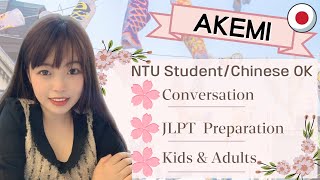
🍀🍀🍀🍀🍀 ABOUT AKEMI-🍀🍀🍀🍀🍀
🇹🇼 Fluent Chinese 🐣 No previous experience with Japanese is also OK!
🇯🇵 Japanese native speaker, the most authentic pronunciation
🎓 National Taiwan University Chinese Literature student
❤️ 400hr+ teaching experience, covering all age groups
⛩ Know Japanese etiquette and traditional culture
💛 Will show you cultural differences and help you make Japanese friends easily~
💼 Practical business Japanese training, don't be afraid to face Japanese bosses💪
🐥Give you insights to different aspects of life in Japan🐥
🍵 Buy 20 lessons and get a free Japanese etiquette lesson
🌸🌸🌸🌸🌸🌸 Class Content 🌸🌸🌸🌸🌸🌸
🐥🐥Introduction to the basics (about 3-6 lessons) 🐥🐥
🧡 Learning Japanese syllabaries
🧡 Nailing pronunciation
🧡 Basic conversational words
🌱🌱Basic Japanese (N5~N4)🌱🌱
📕 Teaching material: Japanese for everyone (Volume 1 and 2)
🧡 Learning basic grammar
🧡 Getting oral practice
🧡 JLPT daily test Dictation practice, quiz test
🍀🍀Intermediate Japanese (N3~N2)🍀🍀
📕 Using suitable for your level textbooks 💛 I’ll design custom materials for every individual student
🖊 Stepping up your Japanese by more intensive listening and speaking 💛 Getting your pronunciation and words usage to a level of native speaker
🖊 Reviewing and correcting your writing
🖊 Training your listening and reading for JLPT, doing mock tests
🌳🌳Advanced Japanese (N1)🌳🌳
📕 Japanese advanced textbooks
🖊 Advanced writing, honorific course
🖊 NHK news listening, reading, translation training
🖊 Training your listening and reading for JLPT, doing mock tests
💁💛 Conversation Lessons:
🔸Learn Japanese in different environments
⛩ Tourist vocabulary/phrases 🍣 Ordering in a restaurant
🚊Buying tickets at the station 👠 Shopping
🔸Encouraging students to speak
🔸Correcting the mistakes and making sure you won’t make them again
💁💛 Dive deep into Japanese culture:
🔸 Introduce Japanese pop culture to you
🔸 Business Japanese, workplace etiquette 💼 Teach you how to deal with Japanese bosses and customers
🔸Japanese life: introduction to food, clothing, housing and transportation, introduction to special travel locations
💁💛 Various customised courses:
🔸 School homework guidance 🖊
🔸Learn Japanese from anime, Japanese dramas, Japanese songs 🎤🎵
🔸Classroom content can be customised according to students' needs
🏆 🏆 🏆 🏆 My student results 🏆🏆 🏆 🏆
Student A: learned from scratch, passed JLPT N3 with the highest score after just one year of preparation 🎉💯💯
Student B: Assisted students to pass the JLPT N2 test 🎊
🌼🌼🌼Why choose me❓🌼🌼🌼
♥️Because AKEMI-sensei has ~
✨400+ hours of teaching experience✨
✨Diverse and fun course content available ✨
✨Develop appreciation for the Japanese language✨
✨Teach you what only Japanese people know ✨
✨Will help you develop the ability to communicate, express and create in Japanese✨
✨In-depth understanding of Japanese traditions and cultural etiquette✨
🌼🌼🌼How to start the course ❓🌼🌼🌼
💟 Step 1) Send a message to me and state your learning goals.
💟 Step 2) 25-minute trial class, get a feeling of my teaching style.
💟 Step 3) After the trial class, I will provide you with a personal learning plan and recommended number of classes
💟 Step 4) Become my student and we’ll move towards your goal together.
✨✨✨✨✨✨✨ CLASSROOM RULES ✨✨✨✨✨✨✨
🔸 If you need to cancel a class, please notify me at least 12 hours in advance.
🔸 Courses cancelled with less than 12 hours notice will be charged the full fee (this is an AmazingTalker policy).
🔸 If a student is more than 10 minutes late, the class will be cancelled and the student will not receive a refund.
🔸 Respect each other's time, please be on time for the class.